

Colin Brush – Author
If it hadn’t been for Dungeness this book would not have been written. Direct quote from the author. However this book is not about Dungeness. The authors inspiration came form observing the various shacks, the stark landscape and the detritus that is littered around the peninsular. Those aware of the area and reading the novel will be able to recognise passages that reflect the authors association with the place.
The modern image of Colin Brush 28th October 2025
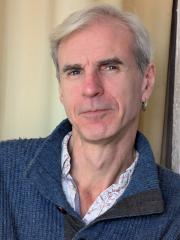
Photo Mike Golding
READ ON
EXO – A debut novel by Colin Brush. involving murder, multidimentions, and the end of the world. For fans of John le Carre, John Scalzi and Kim Stanley Robinson. All very much in the future!!
Banished from Earth, humans eke out lives in orbital habitats – and look with fear at our former home. Centuries ago, the oceans transformed into an annihilating liquid entity – the CAUL – and every living creature that approaches it is irresistibly compelled to enter … and vanish. A few daring scientists seek to understand and stop it, while scavenging the shores of the penitents-those who resit the Caul.
Among those is Mae Jameson, an octogenarian former policewoman who arrived long ago looking for her lost husband. When she encounters a lost child, Siofra, a mute child, alone by the shore, Mae tries to return the girl to her father, rogue scientist Carl Magellan, but finds him hanging from a noose./ He’s been murdered. Unwilling to leave this suspicious death in the hands of the scientists. Carl had fled years ago, Mae takes his journals- which detail his uncovering details of the Caul’s mysteries – and sets about investigating.
In this page turning, dual-timeline novel, both Mae and Carl’s quests for the truth lead them into the heart of a dangerous conspiracy. Someone wants to use the secrets of the Caul to shape humanities future – no matter how many lives must be sacrificed.
RELEASE DATE IN THE UK JANUARY 2026
From Colin
The Call of Dungeness
Does the sea call you? Are you drawn to those heaving grey waters? Are you both awed and terrified by the places where the land ends and another world begins?
I grew up on an island in the English Channel. We moved there when I was six, from the Highlands of Scotland. At just nine miles across and five miles top to bottom, Jersey is small with lots of pretty beaches on the southern, western and eastern coasts, and mostly cliffs on its northern flank. The sea is a constant companion, a reminder that we are cut off. Planes and boats are subject to island weather – fogs shuts the airport, winds stop the boats – and the caprices of the sea cannot be dismissed or ignored. The sea for those who live on small islands is a constant presence in your head. It has power over your movements, it shapes your thoughts. In some ways you might even come to think of it as the God of all things.
Leaving Jersey, I lived in Glasgow and then London for many years. I hid from the sea in cities, though cities with large tidal rivers running through their hearts. In 2004, I visited Dungeness on a day trip, drawn by stories of this mysterious environment where land, sea and sky met in a remarkable setting.
At this point, I knew I wanted to be a writer, and I had been playing around with a couple of novel ideas. I’d already written one set on a time-haunted island. I was starting to write another set in a fantastical city. My imagination, clearly, knew no bounds.
But I was not prepared for what happened during that first glimpse of Dungeness.
Having now visited Dungeness countless times, I cannot remember if my first encounter had one of the two principal kinds of weather I associate with this spot. In my head, it is always either still and foggy, or the sky is clouded over and a strong wind is blowing. This is Dungeness at its most atmospheric. Other experiences are available.
Anyway, driving down the single-track road surrounded by shingle, eyeing houses that looked like little more than shacks and the distant fishing boats lying above the tide line like dead whales, seeing the two lighthouses and then the looming concrete boxes of the nuclear power station, I was overwhelmed by the sense that I’d entered another realm. Once I was out the car and crossing the shingle, heading towards the sea, the feeling of being on the cusp of immense forces grew only stronger. The rusty machinery – winches and bulldozers to haul the boats up the beach – only added to the sense of a place where humankind was struggling to exist, that we had only a toehold in this alien place. Finally, when I arrived at the sea – which, threateningly, surrounds the headland on two sides – I saw a heaving grey mass. Despite the restless liquid movements, it looked almost solid to me. Certainly, utterly opaque.
I love the sea, but this felt like something other. Waves pounded against the shore, roaring and hissing and sucking. Here was an alien entity, something with destructively troubling intentions. To enter it wouldn’t be to just leave behind the familiar solid world. Entering it would mean stepping into another medium, discovering other unseen dimensions. It felt like one-way trip. Going in would mean never returning.
Dungeness, more than any other place I have visited, feels like a zone of transition. Sea, sky, land. They meet and they seem to vie for dominion. I could feel the struggle between these elemental forces over the headland’s existence. I could sense, or at least imagine, the deep time which had shaped this place long before we had arrived and built our flimsy structures across it. I looked around at the lighthouses, the shacks, even the enormous bunkers of the nuclear power station, and we humans seemed so puny and irrelevant by comparison. What mattered our hopes and dreams in face of elements that have been battling it out for geological eras?
I carried a notebook, and I started scribbling ideas about all that I saw. Drawn to the fantastical as my imagination tends to be, I found myself transporting Dungeness to an alien world. The fishing boats were abandoned and broken rocket ships. The old lighthouse became a temple. The shacks became the scavenged homes of the few denizens who lived here. The nuclear power station became a bunker housing and protecting visiting scientists. The shingle headland became a vast plain, hundreds if not thousands of kilometres wide. And the sea? Well, the sea became an antagonist: my story’s adversary. It became the Caul: a liquid entity that irresistibly drew all living creatures to it, all of whom promptly vanished on contact. No one who had entered the Caul ever returned.
I had a strange alien world and I just needed to find a story to tell in it.
I played on and off with the ideas for this story for many years, spending most of time rewriting my fantastical city story. But around 2018 – long after leaving London to live in nearby St Leonards-on-Sea – I gave up on my city and sat down to write the novel that Dungeness had inspired. It was initially set on an alien world. But in 2022, I reworked it so that it was set instead on a far-future Earth. All the elements from Dungeness were to the fore as I told a story of Earth abandoned, the oceans transformed into a deadly grey entity known as the Caul; of scientists struggling and failing to understand it; of a few outcasts who resisted the Caul, living on its shores; and of a lost child being found by an old woman, who discovers the child’s father – a rogue scientist – has been murdered; and of how the reasons for that murder lie in the mysteries and secrets of the Caul itself.
This is Exo, a science fiction murder mystery and my debut novel, published by Diversion Books this autumn in America, but reaching these shores in early January.
Exo is Dungeness. Or at least Dungeness distorted through the lens of my imagination. Dungeness is so much more than the place I have described here. But these fragments I’ve discussed are the elements that won’t let me go.
They keep calling to me. I can’t resist them.
Once you enter Dungeness, there’s no going back.


Leave A Comment